
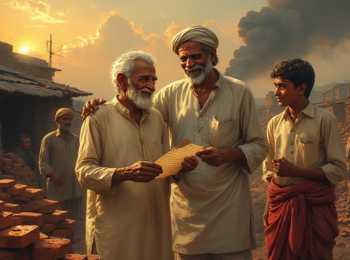
 Raghunath Mehta was busy that day, so he sent his son Arjun to the brick kiln instead. Arjun never liked working there and often got into arguments with customers. But Raghunath wanted him to spend more time at the kiln so that he could learn their ancestral business.
As soon as Arjun sat down in his cabin, the accountant arrived and said, “Sir, an old man has come with a torn receipt. He’s asking for ten thousand bricks.”
“What do you mean?” Arjun asked.
“He says that back in 1968, he deposited ₹150 at the rate of ₹15 per thousand bricks, and now he’s here to collect them.” replied accountant.
“He must be crazy! Today ten thousand bricks cost ₹80,000! How can we give them for ₹150? Send him away.”
“But he has a receipt signed by your father.” said accountant.
“So what? Why didn’t he take the bricks back then? Now, when the price has gone up to ₹8,000 per thousand, he wants them for fifteen rupees?” said Arjun.
While Arjun was scolding the accountant and the old man, Raghunath Mehta himself arrived. Seeing his son in another argument, he asked what was going on.
His son handed him the crumpled receipt.
As soon as Raghunath saw it, he was startled. He looked carefully at the old man and immediately smiled.
“Shyamlal! Where have you been all these years, brother? I waited so long for you after you made the payment. Anyway, your ten thousand bricks are here—take them.” said Raghunath.
“But father,” Arjun objected, “how can you give ₹80,000 worth of bricks for ₹150?”
“Son,” Raghunath said gently, “when he paid the money, that was the rate then. Since 1968, his ₹150 have been invested in this kiln, and from that money we’ve earned profits and grown our business.
We’ve been benefiting from his capital all these years. This receipt bears my signature, and I remember well the day I gave it to him. My father was with me.”
Shyamlal laughed and said, “What if I lose this receipt?”
Raghunath replied, “If you come while I am alive, you won’t even need a receipt—your money will still be safe with me, because I will remember your face. But if you keep this receipt and come after I am gone, you’ll still get your bricks, because honesty runs in our blood.”
Saying this, Raghunath ordered the accountant to deliver ten thousand bricks to the old man’s home.
Then he placed his hand on Arjun’s shoulder and said, “Son, no matter how difficult the circumstances, never abandon the path of honesty. Business thrives on integrity and keeping one’s word. Wealth earned through deceit never stays long.”
Core Learnings from the Story:
Honesty is the greatest asset
– True success in life and business comes from integrity, not shortcuts or deceit.
A promise is more valuable than money
– Keeping one’s word builds lifelong trust and respect that no wealth can buy.
Deceptive wealth never lasts
– Money earned through dishonesty brings unrest and disappears quickly.
Values are the real inheritance
– The morals and ethics passed down from parents are more valuable than material wealth.
Respecting others rights is true righteousness
– Fairness and justice in dealing with others is the highest form of worship.
In Essence:
“Be honest, keep your word and respect others rights because character, not money, is what truly builds lasting prosperity.”
You May also Like: King and Sage Story – How to Handle Burden of Work
Search Keywords: Inspirational Moral Story, Honest Businessman Story, Story On Honesty And Integrity, Moral Story About Truth And Business Ethics, Short Motivational Story In English, Story With Life Lessons, Story About Keeping Promises, Wealth Earned Through Deceit, Value Of Honesty Story, Business Ethics Inspirational Story, Trust And Integrity Moral Tale, Honesty Best Policy Story, Motivational Story For Students, Life-Changing Moral Story, Indian Inspirational Story